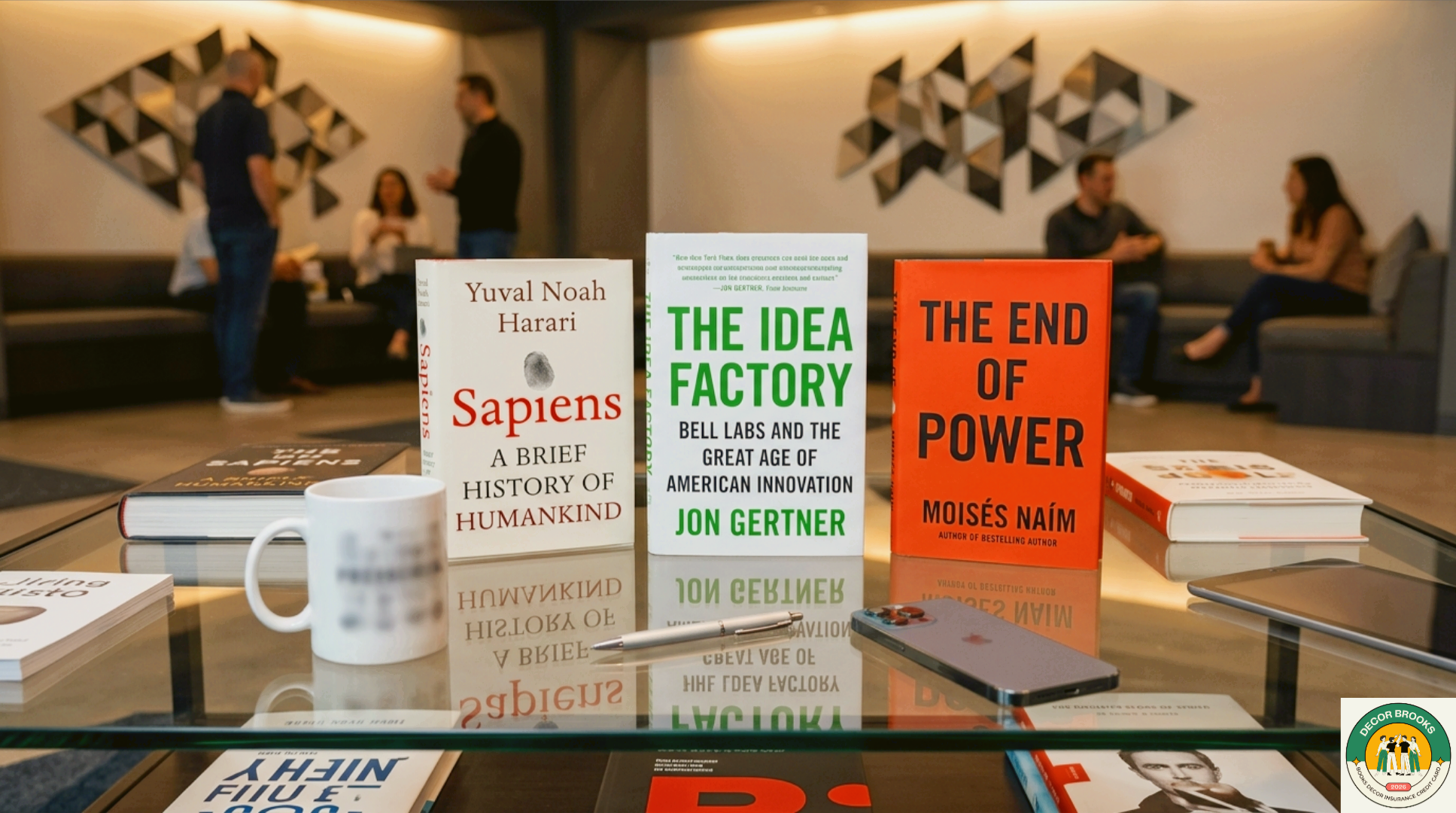
When Meta (Facebook) founder Mark Zuckerberg set a New Year’s resolution to host a public book club called “A Year of Books”, his explicit goal was to read a new book every two weeks. His selections aimed to uncover different cultures, belief systems, histories, and technological trajectories.
By the end of his challenge, he compiled a highly specific list of exactly 23 books. The complete 23-book reading list covers a broad spectrum of human nature, sociology, science, and systemic infrastructure.
The Complete 23-Book Reading List👇
1. The End of Power (by Moisés Naím)
A historical investigation into how traditional positions of authority—in government, military, and mega-corporations—are losing their absolute grip on control to agile individuals.
2. The Better Angels of Our Nature (by Steven Pinker)
A massive, data-driven study showing that despite modern 24-hour news cycles, violence across global human civilization has actually decreased significantly over time.
3. Gang Leader for a Day (by Sudhir Venkatesh)
A gripping account of a sociology professor who embedded himself inside a Chicago gang, revealing how marginalized subcultures build their own economic structures.
4. On Immunity: An Inoculation (by Eula Biss)
An exploration of the science, history, and pervasive social myths surrounding vaccination, analyzing the concept of public health trust.
5. Creativity, Inc. (by Ed Catmull)
The story behind Pixar Animation’s rise, focusing on building a corporate culture that values creative freedom and open peer communication over strict management structures.
6. The Structure of Scientific Revolutions (by Thomas Kuhn)
A landmark 1962 philosophy text that analyzes how scientific advancement doesn’t move in a straight line, introducing the world to the term “paradigm shift”.
7. Rational Ritual (by Michael Chwe)
A book focused on how humans use public rituals, marketing, and media to build “common knowledge,” allowing large groups to coordinate effectively.
8. Dealing With China (by Henry M. Paulson)
An insider’s analysis written by the former US Treasury Secretary tracking the modern economic and social transformation of China into a global superpower.
9. Orwell’s Revenge (by Peter Huber)
An analytical, unofficial sequel to George Orwell’s 1984, presenting an optimistic view that advanced communication networks will ultimately liberate rather than enslave humanity.
10. The New Jim Crow (by Michelle Alexander)
A critical look into civil rights and systemic inequality, focusing on the social and economic consequences of mass incarceration within the US justice system.
11. The Muqaddimah (by Ibn Khaldun)
A 14th-century intellectual text written by an Islamic scholar that acts as a blueprint for modern sociology and historiography, exploring how cities and empires rise and fall.
12. Sapiens: A Brief History of Humankind (by Yuval Noah Harari)
A global history narrative exploring how Homo sapiens evolved from simple hunter-gatherers to master the planet via shared myths like money and human rights.
13. The Player of Games (by Iain M. Banks)
A distinct change of pace from social sciences, this deep science fiction novel explores an advanced galactic civilization driven by artificial intelligence and gaming systems.
14. Energy: A Beginner’s Guide (by Vaclav Smil)
A deep look into the fundamental physical sciences, mapping how human progress has historically scaled based on our efficiency in harnessing energy.
15. Genome (by Matt Ridley)
An accessible mapping of the human genome project across 23 chromosomes, examining human nature through genetics rather than sociology.
16. The Varieties of Religious Experience (by William James)
A philosophical and psychological study of human spirituality, focusing on how personal religious experiences shape individual psychology.
17. Portfolios of the Poor (by Daryl Collins et al.)
An eye-opening study showing how nearly three billion people survive day-to-day on less than $2.50, using incredible financial creativity to manage their resources.
18. Why Nations Fail (by Daron Acemoglu and James A. Robinson)
Based on 15 years of research, this book shows how inclusive political and economic institutions create prosperity, while extractive systems cause long-term collapse.
19. The Rational Optimist (by Matt Ridley)
A book arguing that open free markets are the true source of human evolution, continually generating ideas that solve crises like overpopulation and climate change.
20. The Three-Body Problem (by Cixin Liu)
A world-renowned Chinese hard science fiction novel detailing humanity’s first contact with an alien civilization and the subsequent political chaos on Earth.
21. The Idea Factory (by Jon Gertner)
A history of AT&T’s legendary Bell Labs, mapping the exact environmental factors, questions, and people that sparked massive 20th-century tech breakthroughs.
22. World Order (by Henry Kissinger)
A masterclass on international diplomacy and geopolitics, analyzing how various global factions balance political power to keep global peace.
23. The Beginning of Infinity (by David Deutsch)
Zuckerberg’s final selection, exploring how human progress through art, science, and philosophy is a limitless journey with infinite potential for breakthroughs.